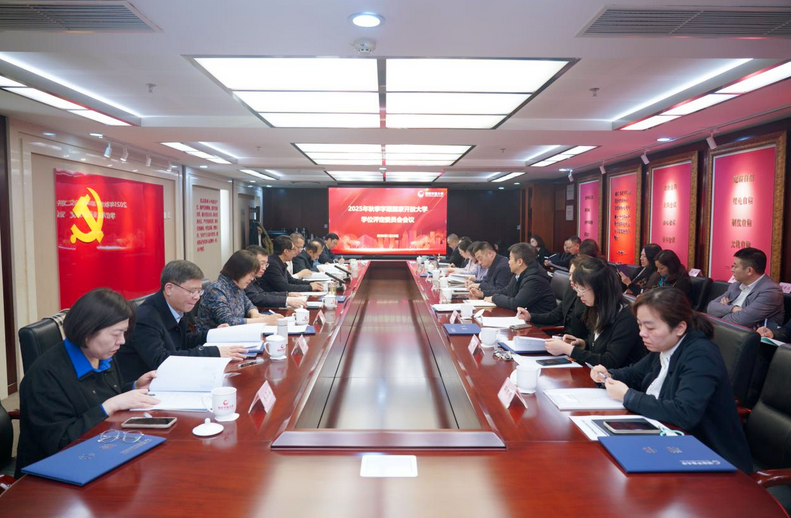
 On 23 January, the Open University of China (OUC) convened the first meeting of its fifth Academic Degrees Evaluation Committee to review the 2025 autumn semester degree conferral work. Dr. WANG Qiming, President of OUC and Chairperson of the Committee, attended the meeting and delivered a speech. Seventeen committee members participated in the meeting, with heads of relevant teaching departments from the headquarters attending as observers. The meeting was chaired by Dr. LI Song, OUC’s Vice President and Vice Chairperson of the Committee.
The meeting listened to the reports on degree conferral from various sub-committees. A total of 10,641 graduates applied for bachelor's degrees in autumn 2025. Following deliberation and voting by the Committee, 7,849 students were awarded bachelor's degrees.
The meeting conducted an in-depth discussion on promoting high-quality development in open education and enhancing degree-conferral practices. The meeting emphasised that the following points. First, it is essential to further clarify the positioning and direction of high-quality development in open education, leverage institutional strengths and aggregate systemic advantages, mobilise resources from the education system and high-quality societal assets, and ride the momentum of digitalisation. The open education framework should proactively assume the core hub role in lifelong education, bridge the divide between institutional and open education, and become the "main platform" and "key supporter" for meeting national lifelong learning needs. Concurrently, it is necessary to enhance public service capabilities for lifelong learning by continuously reinforcing technological, resource, and service advantages, fostering a brand-leading role, and collaboratively building a new ecosystem for high-quality open education development. Second, efforts should be made on establishing a closed-loop quality assurance system for open education degree work, upholding quality standards, prioritising standardised management of degree conferral, clarifying responsibilities at all levels, strengthening oversight of critical stages, and instituting comprehensive end-to-end quality management mechanisms. It is also vital to actively explore evaluation criteria for dissertations tailored to the characteristics of open education which reflects its unique cultivation principles, attach importance to the development of dissertation supervisors within the system, leverage systemic strengths, refine management mechanisms, and build robust discipline-based professional teaching teams. Third, advancing high-quality development through digital-intelligence empowerment is of great importance, which involves utilising artificial intelligence technologies to explore the construction of an integrated, intelligent degree management platform and establishing effective intelligent quality monitoring and early-warning mechanisms for degrees.
By Academic Affairs Department
Photo by ZHANG Jun